Paul WeitzBel CantoFilm DirectingCasting Diversity
Paul Weitz on Bel Canto's Hostage Romance, Real Languages, and the American Pie TV Question
The About A Boy Oscar nominee on adapting the 1996 Peruvian hostage crisis, casting Ken Watanabe and Ryo Kase as romantic leads, and why he keeps an American Pie series at arm's length.
Source material: wingmanmagazine.com
What is Bel Canto about?
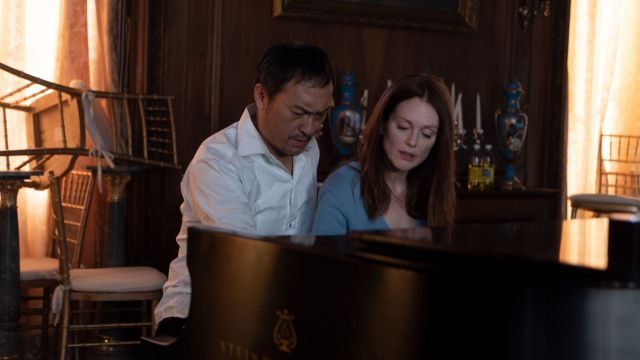
Bel Canto reimagines the 1996 Peruvian hostage crisis, when rebels seized the Japanese embassy in Lima during a party and held hundreds of guests for months. Weitz built two romances into that frame — one between Julianne Moore and Ken Watanabe, another between Japanese actor Ryo Kase and Guatemalan actress Maria Mercedes Coroy, whose dialogue mixes Spanish and her native Kaqchikel. He describes the result as a fable "something like an opera in its structure," keeping one foot in the real hostage situation and the other in a deliberately surreal story. The film is unusual for him because it contains guns — he normally avoids them in movies, but the hostage setting demands them. What drew him in was how mortality sharpens perspective, the territory opera explores without irony. Over the months of captivity, Weitz notes, captors and hostages start identifying with each other, which gives the film its strange tenderness.
Why did Weitz cast the film with so many native languages instead of English?
The casting philosophy is rooted in his own background: Weitz pushed his actors to perform in their native languages rather than default to English. He is part Mexican — his grandmother Lupita Tovar starred in Santa, credited as the first talking picture in Mexico — and wanted the film to reflect that heritage. Maria Mercedes Coroy, whose native language is Kaqchikel, got the part of Carmen partly because the novel's character is learning Spanish, implying it is not her first language. Coroy had made exactly one previous film, shot almost entirely in her native tongue. Tenoch Huerta, who plays Comandante Benjamin, looks "very much" like Weitz's great-grandfather based on photographs from his grandmother's wedding. The result, Weitz says, was a movie "largely visual," supplemented with opera and music, because so many languages are spoken that subtitles cannot carry the whole story.
Who are the romantic leads and why did Weitz cast Japanese actors in those roles?
Ken Watanabe and Ryo Kase carry the film's two romances, and Weitz is explicit about wanting it that way: "the studly guys of the movie are Asian." He had worked with Watanabe on Cirque du Freak and with Moore on Being Flynn, and cast both because he believed they would have chemistry — and because everyone on set would be stuck together, he chose people enjoyable to live beside. Watanabe, he notes, has a great sense of humor and is "a sexy dude," qualities he wanted in a romantic lead of any background. Kase plays opposite Coroy in the secondary romance, and both men speak Japanese on screen rather than switching to English for international audiences. Weitz calls it unusual to have two Japanese men as romantic leads in an American film, and he is proud the casting gives Asian actors leading roles that do not flatten their language or culture.
How did Bel Canto get made?
Producers brought Weitz the novel on which Bel Canto is based; he did not seek it out. Anthony Weintraub wrote the screenplay, and he and Weitz went to college together, which made the collaboration easy. Weitz says he normally avoids reading with an eye to adaptation because it spoils the pleasure of reading — but this novel struck him as both beautiful writing and a story that worked as a fable. He also connects the project to a shift in his interests: his earlier films were often about mentorship and seeing one's own flaws while teaching someone else, while Bel Canto takes on larger existential themes instead. That shift is what pulled the opera elements in. The shoot required the cast to live close to one another near the set, since anyone not in a scene was still in the background of the scene — effectively, everyone was a hostage for the duration.
How does opera shape Bel Canto's structure?
Renee Fleming's observation about the opera Rusalka became a structural key for Bel Canto: "It's like the Little Mermaid, but it's opera, so everyone dies in the end." Weitz liked it so much he had the line put into the film as dialogue, because it applies directly to the narrative's fatalism. Operas, he says, talk about the most important things without feeling the need to dip into irony, and Bel Canto follows that model — a classic opera tale in cinematic form. The film also incorporates opera singing into its soundtrack, adding another language to the mix that Weitz was still learning while making the movie. He spent time with Fleming during production — she is "very funny, among other things" — and she gave him not just the Rusalka line but a sense of how opera's otherworldliness could shape the film's romantic and mortal stakes.
The American Pie TV Question
Paul Weitz laughs off the idea of an American Pie television series, saying 'wiser heads than mine are probably pondering that' and calling it 'a funny idea for sure' before deferring to studio executives. The original film was a blockbuster that launched an unstoppable franchise, and Weitz directed it when its young cast were unknowns—Seann William Scott was working at Home Depot at the time. His own About A Boy made the jump to TV after the film, and American Pie has sustained itself across multiple sequels, showing the property's lasting appeal. Weitz's fourteen-year-old daughter recently told him she watched the movie for the first time at a friend's house, a milestone he relays with amusement, suggesting the comedy still resonates with new generations. For now, though, his focus is on other projects entirely—he is currently writing an adaptation of Lee Ann Moriarty's novel 'What Alice Forgot,' and he has also directed acclaimed films like 'Grandma' and 'In Good Company.' While a TV version remains hypothetical, Weitz's track record with both film and television—including the Emmy-winning 'Mozart in the Jungle'—means any such project would have a strong creative foundation, but he seems content to let wiser heads decide.
What else has Paul Weitz directed and written?
His resume spans American Pie, the Academy Award-nominated About A Boy, and Being Flynn with Robert De Niro and Julianne Moore. He also directed Grandma, written specifically for Lily Tomlin after he met her on the set of Admission — he decided she was "incredibly smart and poignant" and built the movie around her. His television credits include the Emmy-winning Mozart in the Jungle and the TV adaptation of About A Boy. The range across these projects — gross-out teen comedy, literary drama, a Lily Tomlin vehicle — is the point: he has avoided being pigeonholed into a single genre. He describes himself as a complete filmmaker, writing, producing, and directing, and his collaborators have included Dennis Quaid and Topher Grace. He also directed In Good Company and the drama American Dreams, and he views each project as a distinct challenge rather than a brand extension.
What is Weitz working on next?
Weitz is writing an adaptation of Lee Ann Moriarty's novel What Alice Forgot, which he confirms as one of several projects in progress. The novel, about a woman who loses years of memory, aligns with the mortality-and-perspective theme that has driven his recent work, the same impulse that drew him to Bel Canto. He also continues to work in television, where his Mozart in the Jungle won an Emmy. Beyond his writing and directing slate, he occasionally acts when asked — he played a peasant in Jeff Baena's The Little Hours, a role he took because it reminded him what actors experience: long waits followed by a ten-minute scene at 3 AM. He says he is "learning to learn and to not be a fake," suggesting each project is a chance to stretch rather than repeat a formula.
Which actors does Weitz want to work with again?
Seann William Scott, who was working at Home Depot when he landed American Pie, is someone Weitz would gladly direct again. He calls Scott a "wonderful actor" and still admires the clean slate of that production: Chris Klein had shot Election but had not been released yet, and none of the main cast was established. Weitz's casting philosophy is that he tolerates crazy people but avoids mean ones, and he looks for actors who are "really fantastic" at the craft. Harvey Keitel is someone he worked with briefly and would revisit. He believes there are great actors who never get the role that would make them famous, and he considers finding them part of his job — the same instinct that led him to write Grandma for Lily Tomlin after a single set encounter.